A two-person startup and a fifty-agent support org are not buying the same thing when they buy a help desk — and the most common startup mistake is buying the fifty-agent product on day one. This guide maps what to buy at each stage, with real prices (checked on vendor pages and recent third-party breakdowns, September 2026), honest limits of the free tiers, and the five triggers that tell you it's time to move up. All reviews here are research-based: pricing pages, documentation, and September-2026 third-party analyses — no affiliate links, no fabricated trial claims.
- At 1–3 people, start on a genuinely free tier (Zoho Desk's free-for-3-users edition or HubSpot's free tools) — do not pay for software before you have the volume.
- At 4–10 agents, Freshdesk Growth ($19/agent/mo, checked Sept 2026) and Zoho Desk's paid tiers are the value picks; watch which features are tier-gated.
- At 10–25 agents, the decision becomes about AI pricing and reporting depth, not the seat price — Fin's $0.99/outcome and Zendesk's per-resolution billing can dwarf seat costs.
- At 25–50+ agents, you're buying SLAs, workforce management, and auditability; suites like Zendesk Suite Professional ($115/agent/mo) and Intercom Expert ($132/seat/mo) enter the frame.
- The cheapest mistake is buying the enterprise product too early; the most expensive mistake is staying on a free tier past the point where tickets are being lost.
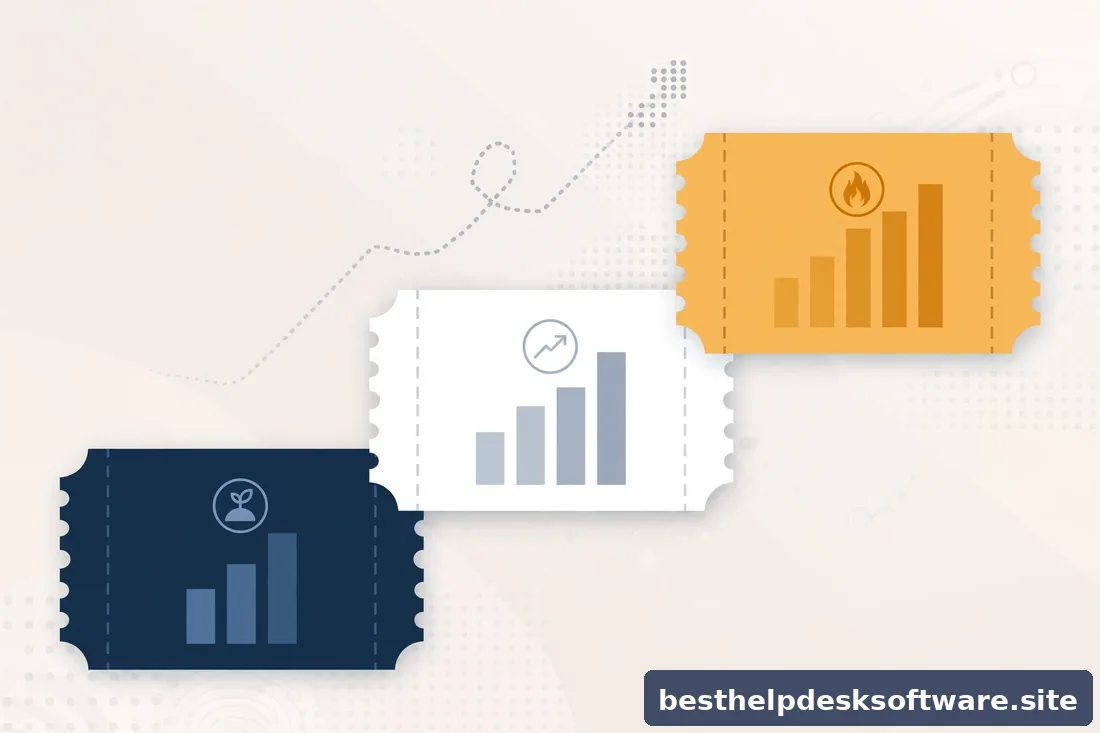
Stage 1: 1–3 people — the free tier is enough
If three people answer everything and ticket volume is under a couple hundred a month, you do not need paid software. What you need is a shared ticket queue, a basic knowledge base, and email in/out. Three options cover this genuinely free:
Zoho Desk Free Edition — free for 3 users, and unlike most free tiers it includes email ticketing, a help center, and a knowledge base rather than a hollow trial-in-disguise. Per Zoho's pricing page (checked Sept 2026), the free edition has real limits on automation and reporting, but for a founding team it is the most complete free desk available.
HubSpot's free tools — free for 2 users with ticket pipelines and basic automation. The catch is the ceiling: it's 2 users, and the moment you need a third seat you're into Starter at roughly $9–15/seat/mo (checked Sept 2026). Fine for a founder plus one, not for a team of four.
Help Scout — a free tier covering 5 users with a 100-contact cap, which works if your customer base is still small.
What to skip at this stage: anything with per-seat pricing above $20, any "AI agent" add-on, and any platform that requires onboarding fees (HubSpot's paid tiers carry ~$1,500–3,500 onboarding — that alone should tell you those tiers are not for stage 1). Also skip the shared Gmail inbox the moment two people start answering the same thread — collision and zero audit trail are how tickets get silently dropped. Our companion guide on shared inboxes vs help desks covers the exact upgrade signals.
The stage-1 rule of thumb: if you can't yet say how many tickets you get per week, you don't have the data to choose paid software. Get the free tier, run it for a quarter, and let the reporting tell you what you actually need.
Stage 2: 4–10 agents — the value picks
At 4–10 agents you have real volume, probably one or two channels beyond email, and your first hire whose job title includes "support". This is where per-seat pricing starts to matter and where tier-gating starts to bite.
Freshdesk Growth at $19/agent/mo (checked Sept 2026 — see this third-party Zendesk/Freshdesk pricing breakdown for the cross-vendor context) is the most common value pick at this stage: email ticketing, a knowledge base, and automation rules that cover most small-team workflows. The catch, per Freshdesk's pricing page, is the ladder above it — Growth to Pro is $19 to $55, and features like SLAs and advanced automation sit behind that jump. Buy Growth knowing exactly which Pro feature you'll need next, and at what headcount.
Zoho Desk's paid tiers undercut almost everyone: roughly $7–20/agent/mo for Express and Standard (annual billing, checked Sept 2026). If your stack is already Zoho (CRM, Books, etc.), the ecosystem integration is the real prize — ticket context flows into CRM records without middleware.
Zendesk's Support Team at $19/agent/mo exists but is email-only — no chat, no help center. Most startups that try it outgrow it within months and end up on Suite Team at $55/agent/mo, which is the honest Zendesk entry point. Zendesk also runs a Startups Program covering up to 50 agents for 6 months (per third-party breakdowns, Sept 2026), which is worth applying to if you're venture-backed or in an accelerator — six free months of Suite-level tooling buys real runway.
A worked cost at 8 agents: Freshdesk Growth = $152/mo; Zoho Standard ≈ $112–160/mo; Zendesk Suite Team = $440/mo. That gap is the price of Zendesk's depth — and at 8 agents, depth you don't use is just margin you're donating.
Stage 3: 10–25 agents — the growth desks
At 10–25 agents the conversation stops being about seat price and starts being about three things: AI pricing, reporting depth, and channel sprawl.
The AI billing shock. This is the stage where teams discover that the seat price was the floor, not the total. Fin (Intercom's AI agent) bills at $0.99 per outcome — charged at most once per conversation — which sounds trivial until you multiply it by a few thousand conversations. Zendesk's AI agents bill per automated resolution at roughly $1.50 committed / $2.00 pay-as-you-go (third-party analyses, Sept 2026). A team with 2,000 AI-resolved conversations a month is looking at $2,000–4,000/mo in AI billing alone, on top of seats. Model this before you sign: take your current monthly conversation volume, assume the AI resolves 40–60%, and multiply. Our breakdown of AI agent pricing models walks through the worked math.
Intercom at this stage: Essential $29, Advanced $85, Expert $132 per seat/mo (annual, checked Sept 2026 — see Gleap's Intercom pricing analysis). Intercom is strongest for product-led SaaS teams whose customers live in-app; it's weakest for teams that need heavy email ticketing or voice. The Copilot add-on ($29/agent/mo) layers on top.
Freshdesk Pro at $55/agent/mo adds SLAs, custom roles, and deeper automation — the features that stage-2 teams kept bumping into. Zendesk Suite Growth at $89/agent/mo (per third-party data; the public card has been inconsistent in 2026) and Suite Professional at $115/agent/mo add skills-based routing, IVR, and real reporting.
The stage-3 rule: pick the platform whose add-on pricing you can afford, not whose seat price looks cheapest. Seats grow with every hire; AI usage grows with every automated conversation.

Stage 4: 25–50+ agents — the suites
At 25+ agents you're buying governance: SLAs with teeth, workforce management, custom roles, sandbox environments, audit logs, and usually voice. This is where Zendesk Suite Professional ($115/agent/mo, Enterprise on quote ~$169+), Intercom Expert ($132/seat/mo), and Freshdesk Enterprise ($89/agent/mo, annual) compete — and where procurement, security reviews, and annual contracts become unavoidable.
Two things change at this stage. First, annual contracts with negotiated discounts become the norm — list price is a starting point, and Q4 is when vendors discount hardest (our Q4 buying playbook covers the negotiation levers). Second, migration cost becomes real: exporting tickets, rebuilding automations, retraining agents. Switching platforms at 40 agents is a multi-month project; our migration playbook lays out the five-phase plan.
The stage-4 pick depends on your channel mix: voice-heavy teams should price Zendesk's Contact Center add-on ($83/agent/mo, checked Sept 2026) or Freshdesk's Omni bundle ($79/agent/mo at Pro) into the comparison from day one — bolting voice on later is where the surprise invoices come from.
Five triggers that say "migrate now"
Don't migrate on vibes. Migrate when you can point at one of these:
- You're paying for seats that don't include the features you're using. The classic: paying for Freshdesk Growth while running SLA timers manually in a spreadsheet. The next tier up is cheaper than the labor.
- AI billing exceeds 30% of your seat bill. When the AI line item is a third of the invoice, you're on the wrong plan or the wrong vendor — renegotiate the committed rate or switch.
- Agents maintain workarounds in other tools. If routing logic lives in Zapier, reporting lives in Sheets, and SLAs live in someone's head, the desk has stopped being the system of record.
- You can't answer "what's our first-response time?" If the platform's reporting can't produce your basic KPIs without exports and pivot tables, you've outgrown it. (The six KPIs worth tracking are a good audit checklist.)
- Onboarding a new agent takes more than a day. At scale, permission roles, macros, and guided workflows are the difference between a week of shadowing and a day of self-serve ramp.
Any two of these together mean the migration pays for itself within a year — usually within two quarters once you count the manual work it eliminates.
Three mistakes startups keep making
Buying the suite on day one. A three-person team on Zendesk Suite Professional is paying $345/mo for routing features they'll need in year three. The money is better spent on the knowledge base the AI will eventually read.
Ignoring the free tier's export terms. Some free tiers make it painful to leave — limited exports, proprietary formats. Before you commit a year of ticket history to any platform, check what an export looks like. It's the cheapest insurance in this guide.
Letting the founder's inbox stay the system of record. The founder answering support email directly works until it doesn't, and the failure mode is silent: customers who stop writing because replies take four days. The free tier exists precisely so this never has to happen.
—
FAQs
What is the cheapest real help desk for a startup?
Zoho Desk's free edition (3 users) is the cheapest credible option — $0 with real ticketing and a knowledge base. Among paid tiers, Zoho's Express (~$7–9/agent/mo) and Freshdesk Growth ($19/agent/mo) are the value picks. All prices checked September 2026; verify on vendor pages before you buy.
When should a startup leave the free tier?
When any of these are true: you have more than 3–5 agents, you need SLAs or real reporting, or tickets are being missed. Most teams hit this at 4–8 agents or a few hundred tickets a month. The full free-tier comparison lists every credible free plan with its real limits.
Is Zendesk worth it for a small startup?
Usually not at stage 1–2 — the honest entry point is Suite Team at $55/agent/mo, and most of its depth goes unused below 15 agents. It becomes worth evaluating at 20+ agents, or earlier if you can get the Startups Program's 6 free months. This is a research-based assessment, not a first-hand trial.
How much does AI support cost for a startup?
It depends on volume, not headcount. Fin at $0.99/outcome or Zendesk at ~$1.50/resolution means 500 AI-resolved conversations cost roughly $500–750/mo — often more than the seats themselves. Startups should pilot AI on a capped volume before committing.
Can we switch help desks later without losing tickets?
Yes, but it's a project, not a button — exports, automation rebuilds, and a parallel run. Plan for it from the start by checking export options before you commit. See the migration playbook.